
Demand has never been bigger. The systems running these businesses have never looked smaller. The window to fix that is the same window the rebate runs in.
It’s Friday afternoon at an Australian solar installer doing 40 installs a week.
The sales manager is updating prices. A supplier note came through this morning — STC factors moved, panel cost up four percent. He’s updating the job system. Then a pricing spreadsheet. Then the design tool. Then another spreadsheet the call team lives in. Four places. He’ll miss one and find out on Monday.
A contractor texts: “Got 14 panels in the ute, nobody told me where they’re going.” The ops coordinator opens her inbox, then a spreadsheet, then the job system. The job got rescheduled yesterday. Nobody told the contractor. The panels live in his van for the weekend.
The CFO emails. She wants this week’s margin number on Monday morning. Someone will spend Sunday afternoon assembling it from four exports.
The CEO is on a call. He’s just been told that one of the bigger groups in the state is hiring for an admin role — their fourth this quarter. The growth is real. So is the operational drag.
This is the operating model of an Australian solar installer in 2026. It’s not broken. It’s working. It just doesn’t scale.

The Cheaper Home Batteries Program put more than 350,000 batteries on Australian roofs in its first ten months. The Clean Energy Regulator is processing roughly 8,000 applications a week. Federal funding scaled from A$2.3B at launch to A$7.2B by December 2025. NSW alone captured 38% of all federally-rebated batteries in July — more than Queensland, South Australia and Victoria combined. The Smart Energy Council expects half of Australia’s four million existing solar homes to install batteries.
The 1 May 2026 STC cliff knocked the factor 19% overnight. The week before, reputable NSW installers were booked 8–10 weeks out and turning customers away. That demand didn’t disappear — it moved to the operators who could absorb it. The federal program runs at scaled funding through 2030.
There is no equivalent demand surge in living memory for the businesses doing the installs.

I’ve spent the last several months in deep discovery with solar installers — businesses doing 25 to 60 installs a week, ambitious, well-led, with strong customer reputations. The pattern is uncannily consistent. Six to eight separate systems running the business. A trade job management platform. A separate solar design tool. Pricing spreadsheets that get re-keyed every time a supplier moves. Another spreadsheet the install team lives in. A marketing automation tool that doesn’t talk to the CRM. A safety inspection app. A bills-and-AP tool. Xero for the books. Nothing talks to anything else cleanly.
The pain shows up in the same six places, every time.
Scheduling. A job gets rescheduled and three people need to be told: customer, contractor, inspector. Three different channels, all manual.
Contractor management. Who’s available this week? Who’s certified for which job? Whose insurance lapses next month? What stock is sitting in whose van right now? Almost never in one place.
Supplier orders. Panels, inverters, batteries, BOS. Ordered in one system, received in another, allocated to jobs in a third. Reconciled monthly if at all.
Sales-to-install handoffs. Deal closes. Job needs to be built. Deposit needs to be invoiced. Site needs to be inspected. Contractor needs to be scheduled. Customer needs to be kept in the loop. Each step lives in a different tool, and the integration is a human re-keying numbers.
STC submissions. The compliance machine. Inspection photos, paperwork, customer signatures, system specs — assembled by hand for every job. One missing piece holds the rebate.
No single point of visibility. The CEO asks “how are we tracking this week?” and the answer takes a day and three exports to put together. By the time the picture is clear, the moment to act on it has passed.
The only growth lever this operating model offers is hiring. More schedulers. More coordinators. More admins. The fastest-growing line in the the cost base of a 40-installs-a-week business isn’t installers. It’s back office.
Hiring is not a platform.

This isn’t an abstract observation. The Australian solar market is consolidating in real time, and the buyers know exactly what they’re looking for.
1KOMMA5° has put roughly A$100M into Australian acquisitions since 2022 — Natural Solar, Solaray Energy, Kozco Energy, Arkana Energy Group. Origin Energy exited installation in December 2024 and bought SolarQuotes instead. Rinnai acquired Smart Energy Group. AGL paid Tesla tens of millions for the South Australia Virtual Power Plant. Omnidian bought Solar Service Guys to anchor its Australian expansion.
The pattern is consistent. Well-funded buyers are picking up operators with scale, systems, and clean books. They’re walking past the operators running the business on tribal knowledge and Excel. Bain & Company’s 2026 Global Private Equity Report finds the same dynamic globally — high-quality assets are attracting the strongest buyer interest.
At the same time, the regulator is enforcing. The Clean Energy Regulator’s battery inspection program rated 60.8% of inspected installs substandard. Solar Accreditation Australia capped each accredited installer at two systems a day from 1 September 2025. NETCC and NSW Fair Trading suspensions are public, permanent, and increasing. SunWiz reports residential-only solar businesses suffered a 10% revenue decline in 2024 alone.
The operators who make it through this wave aren’t the ones with the best CRM. They’re the ones who stopped running six.
This is solvable. We know because we’ve solved it.
RenewCo Solar is an Australian, family-founded installer. They came to us at the same crossroads — explosive demand, premium support model, growth ambition, and a tech stack stitched together from when they were a much smaller business. Customer support was running on WhatsApp groups, one per customer. Beautiful at small scale. Unmanageable past a certain size.
We unified their operation onto a single Salesforce platform. Sales, service, field service, customer mobile app, AI on top. Twelve months in, the numbers we’ve reported publicly with them:
The results speak for themselves
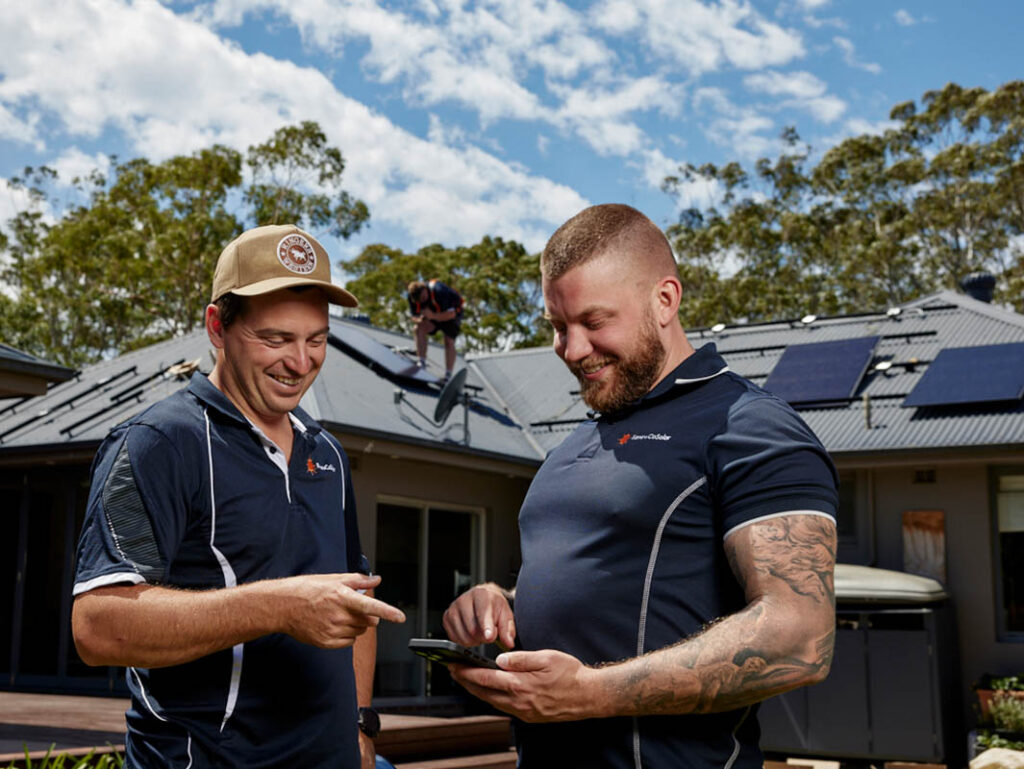
Mark Summerville, RenewCo’s COO, told the story on stage at Salesforce Agentforce World Tour Sydney in February. The full case study is at arcturious.com/renewco-case-study.
What changed wasn’t the CRM. What changed was the operating model. One platform, one customer record, one place to make a price change, one place to dispatch a job, one place to see how the business is tracking. The AI layer sits on top of that — it can’t work without the foundation underneath it.
“Working with Arcturious, we have not only enhanced the overall customer experience, but now have a platform that provides us with limitless potential to scale and effectively service a growing number of customers.”
– Mark Summerville | Chief Operating Officer – RenewCo Solar
If any of the above sounds familiar, three diagnostics to run before the week is out.
Count your subscriptions. Every SaaS bill in the business. If it’s more than five, that’s the article. If it’s more than eight, you already know.
Map a single quote-to-cash flow on a whiteboard. From lead in to invoice out. Mark every hand-off between systems. Every place a human re-keys a number. Every place a job lives in two tools at once. The picture is the diagnosis.
Time how long it takes to build this week’s report. Installs done, revenue booked, pipeline coverage, contractor utilisation, margin by region. If it takes more than half an hour and one person, the system isn’t working.
Then read the RenewCo case study. Then give us a call.
Demand has never been bigger. The systems have never looked smaller. The window to fix that is the same window the rebate runs in.

Michael Diamond is Director and Lead Solution Architect at Arcturious.
An AI-augmented Salesforce consultancy based in Sydney. Arcturious is a two-time Salesforce Global Partner Innovation Award winner — Connected Ecosystem (2022) and Energy & Utilities (2024).
Clean Energy Regulator, Quarterly Carbon Market Report Q4 2025
Clean Energy Council, Rooftop Solar and Storage Report Jul–Dec 2025
SunWiz market reports, 2024–2025
Smart Energy Council industry briefings
Salesforce customer story, “RenewCo Solar powers efficiency and growth with Agentforce”
SmartCompany, “How AI agents are helping RenewCo Solar redefine the future of Australian renewables,” January 2026
Bain & Company, Global Private Equity Report 2026
Don’t experiment with AI in isolation.
If your stack has grown past what your team can hold in their heads, we’d like to talk about why.